

AARP Highlights What FTD Caregivers Need to Know
It’s subtle changes in speech and behavior, not memory loss, that is often the first sign of FTD, said AARP in a recent article on its website.
FTD is less widely recognized than Alzheimer’s but often more disruptive because it strikes at the core of who a person is, affecting areas governing impulse control, social behavior, empathy, and communication. FTD is frequently misdiagnosed, often taking two to three years for confirmation.
“Early symptoms are frequently subtle or mistaken for stress, depression or psychiatric illness,” said AFTD CEO Susan L-J Dickinson. A once-reliable family member may begin making poor financial decisions, she said, or acting socially inappropriately, all without recognizing anything is wrong.
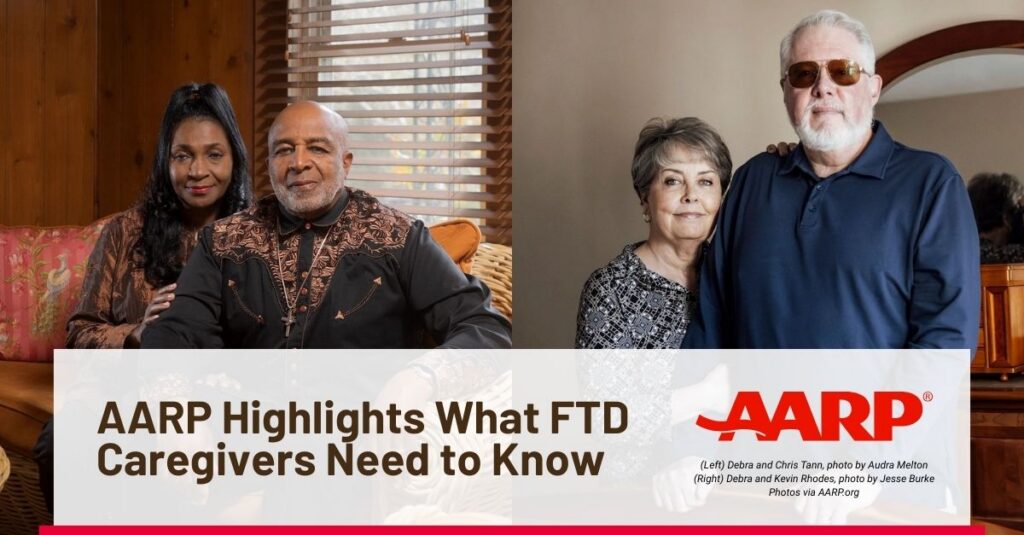
When Chris and Debra Tann of Valdosta, Georgia, received Chris’s FTD diagnosis in 2019, it brought an unexpected benefit. “The diagnosis was devastating, but it also gave us clarity,” Debra told AARP. “Once we understood what we were dealing with, we stopped asking, ‘Why is this happening?’ and started asking, ‘How do we live well with this?'”
Today, Chris, a member of AFTD’s Persons with FTD Council, participates in research and support groups. Debra works tirelessly to advocate for caregivers and erase stigma.
For Kevin and Debra Rhodes of Nashua, New Hampshire, early signs appeared in Kevin’s work. Once successful in health care technology sales, he unexpectedly lost a series of jobs. After nearly three years, a neurological referral led to his diagnosis.
“FTD didn’t just change Kevin’s behavior, it changed the entire rhythm of our lives,” his wife told AARP. “Because Kevin still looks and sounds like himself, people don’t always see what I’m managing behind the scenes.” Kevin is co-chair of AFTD’s Persons with FTD Council.
“People with FTD are often first diagnosed with a psychiatric condition because the earliest symptoms reflect changes in behavior, personality and emotion, rather than memory,” says Richard Ryan Darby, MD, a member of AFTD’s Medical Advisory Council and director of the Vanderbilt Frontotemporal Dementia Clinic.
Rita B. Choula, AFTD Board chair, spent more than a decade caring for her mother, who lived with behavioral variant FTD. One defining moment came when Choula had her first child. “Mom appeared expressionless while holding her granddaughter for the first time—no joy, laughter or affection toward me or her first grandchild,” Choula told AARP.
The long journey to diagnosis shaped Choula’s commitment to building awareness. She advises FTD caregivers to trust what you’re seeing and advocate persistently for accurate diagnosis. Find an FTD specialist at major academic medical centers, and remember that behavioral symptoms, not memory loss, are often most distressing. “For caregivers, the loss of emotional awareness, especially during milestones, can be profoundly painful,” Choula told AARP.
For more information about FTD support and resources, visit theaftd.org or call the AFTD HelpLine at (866) 507-7222.
Further reading:
- The article on the AARP website
- Chris Tann’s article on managing anxiety as a person diagnosed with FTD
- Kevin Rhodes’ articles on tracking FTD behaviors and anosognosia
- AFTD’s Persons with FTD Advisory Council
- Find an FTD Diagnostic Center near you
By Category
Our Newsletters
Stay Informed

Sign up now and stay on top of the latest with our newsletter, event alerts, and more…


