


Support
When Helen-Ann Comstock founded AFTD in 2002, she wanted to ensure that no one would face a diagnosis alone. Today, guided by people living with FTD, our Medical Advisory Council, and leading experts, our programs and resources educate and support individuals, care partners, and families at every stage of the journey.
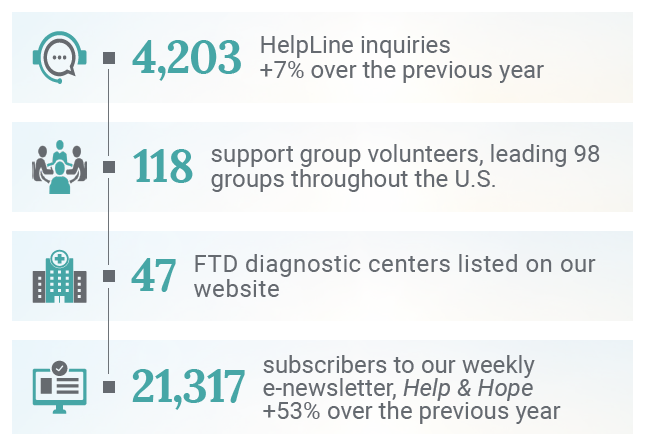
AFTD’s HelpLine is often the first place people turn to after receiving an FTD diagnosis. Staffed by three social workers and a genetic counselor, it offers guidance on locating experienced care providers, managing care, coping with grief, addressing challenging behaviors, and accessing community support.
In addition to providing tailored guidance and support, HelpLine staff regularly contribute to Help & Hope, AFTD’s weekly e-newsletter, and webinars, such as Navigating Behavioral Variant FTD Symptoms and Navigating the Holidays with an FTD Diagnosis, alongside members of the Persons with FTD Advisory Council.


AFTD Support
To find support near you, visit theaftd.org/living-with-ftd/aftd-support-groups

In fall 2024, we launched an interactive map to help users easily locate FTD support groups and diagnostic centers.
Comstock Grants: Providing Financial Support
Managing an FTD diagnosis can cost an estimated $120,000 annually — nearly twice that of Alzheimer’s disease*. Our Comstock Grant program provides direct assistance to persons diagnosed or current care partners and caregivers.
Each grant can fund respite care, counseling, self-care activities, medical supplies, home modifications, and attendance at educational events, providing meaningful relief for families navigating this challenging journey.
We required bathroom renovations to allow a walk-in shower when [my wife’s] mobility declined to allow easy access, a shower chair, and enough room for her carer to assist.
- Quality of Life grant recipient
I am caring for my mother in my home, who has FTD; however, I also have two small children (ages 5 and 8). We used this grant to help cover the cost of her care while we did some family activities.
- Respite grant recipient
*Galvin, J. E., Howard, D. H., Denny, S. S., Dickinson, S., & Tatton, N. (2017). The social and economic burden of frontotemporal degeneration. Neurology, 89(20), 2049–2056.
Grants Awarded

Led by trained and dedicated AFTD volunteers, support groups are a vital resource for persons diagnosed, caregivers and care partners, and family members. Offered in-person and virtually at local, regional, and national levels, they provide a safe space to share experiences, learn how to advocate, and gain coping skills for navigating FTD.
Approximately 20 percent of people diagnosed with FTD have an underlying genetic cause. In addition to our support groups for People at Confirmed Genetic Risk and Familial FTD Peer Support, we continue to expand resources to address the unique needs of families facing a genetic variant, including a new resource on gene therapy and a webinar, How to Find a Genetic Counselor, offering practical guidance on counseling options and their benefits and limitations.


