

Education
Through various initiatives, we educate healthcare professionals to recognize FTD symptoms for earlier, more accurate diagnosis, share best practices in care, and inform the public about research participation, support options, and advocacy — improving the journey for all affected.
Since 2010, AFTD’s annual Education Conference has brought together people affected by FTD, researchers, and healthcare professionals to learn and connect. In 2025, the agenda expanded with a half-day Genetic FTD Symposium addressing common misconceptions, counseling and testing options, and ways to advance research.
2025 Education Conference Attendees


For the second year, our FTD in the Arts exhibit was displayed at the conference, featuring 25 works of art selected from 90 entries by 63 artists worldwide.

Katie Brandt, MM, an FTD advocate, former caregiver, and longtime volunteer, delivered the keynote address at the 2025 conference, held on May 1-2 in Broomfield, Colorado, and broadcast online. The agenda featured eight plenary sessions and 12 breakout sessions presented by 53 speakers.

Emma Heming Willis closed the conference by thanking our dedicated community and highlighting the many opportunities to engage with our mission.

As part of AFTD’s Healthcare Professional Webinar series, we presented three webinars offering continuing education credits. Topics included diagnostic criteria for PPA, interactions with law enforcement by persons diagnosed, and the role of speech therapy in the FTD journey.
Recordings from the 2025 Education Conference and Healthcare Professional Webinar series are available on AFTD’s YouTube channel.
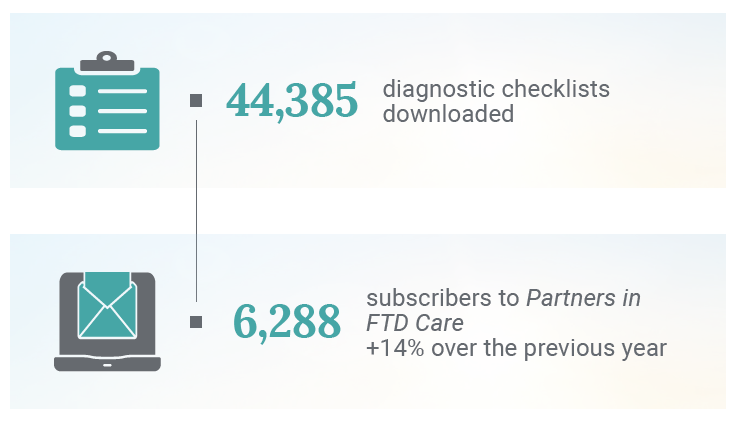
Launched in 2022, AFTD’s diagnostic checklists for bvFTD and PPA help both family members and clinicians identify common symptoms while encouraging earlier referrals to medical specialists. This year, we created a checklist to support families seeking an FTD-ALS diagnosis.
Provider Outreach Volunteers help raise FTD awareness among healthcare professionals to improve diagnosis and care. Since launching this initiative in October 2024, 50 volunteers have visited providers in their communities, sharing materials with more than 70 clinics, care facilities, and medical offices.
AFTD's bimonthly e-newsletter, Partners in FTD Care, provides guidance on best practices in diagnosis and care, as well as information on FTD-focused studies that are actively recruiting volunteers.


AFTD Downloads & Subscribers
Impact Report 2025
This work is made possible by our generous volunteers, donors, and partners. Thank you for your continued support.