
World FTD Awareness Week Guest Feature: Advocating for the Future, Advocating for Love – Insights From a Lifelong FTD Journey
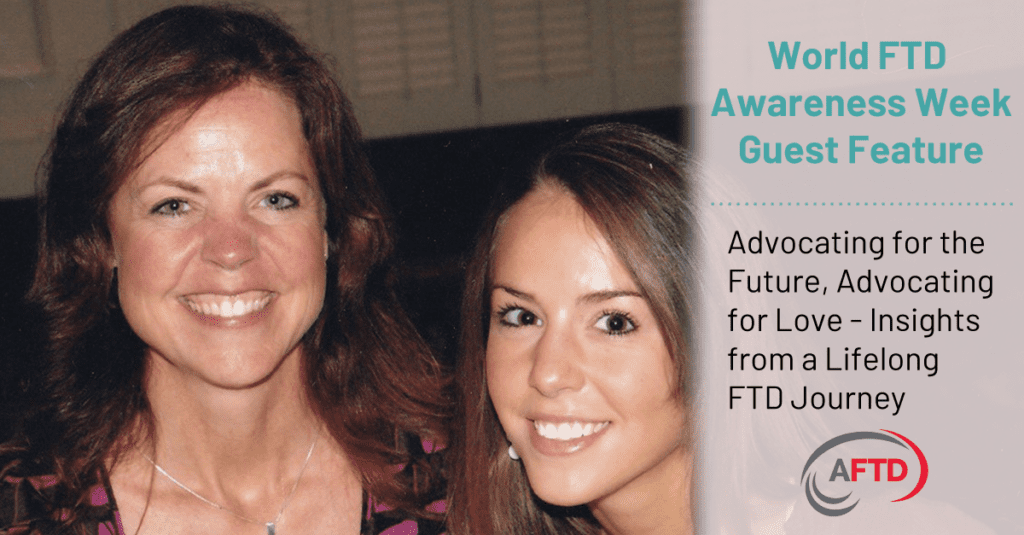
Despite the grief, frustration, and sadness that can affect families on the FTD journey, many have channeled those experiences positively, using them for motivation to create a better future for others affected by the disease. For Linde Lee Jacobs, her lifelong experiences with FTD and her love of her family helped shape her into a strong advocate.
“I have two motivators for why I advocate,” Lee Jacobs said. “Half of it is what I went through with my mom and everything that went wrong. The other half is because I don’t want my kids to have to do any of this. I’m trying to prevent a future where this is scary for them, and they have to worry about FTD.”
For World FTD Awareness Week, AFTD sat down with Lee Jacobs to discuss advocacy and how it doesn’t always involve contacting legislators or talking to reporters.
A Lifetime of FTD
“My whole life, my grandmother was sick,” Lee Jacobs told AFTD. “When I was younger, I didn’t recognize the symptoms – that was just who my grandmother was.”
Specifically, Lee Jacobs said, her grandmother began hoarding, filling her home with random items. As her symptoms progressed, she was moved to a care facility, a decision partly motivated by her aggressive behavior toward Lee Jacobs’s grandfather.
After her death in 2006, Lee Jacobs pushed for an autopsy to confirm her diagnosis. The autopsy report said she had a “tauopathy causing FTD,” and the medical examiner said it appeared to be a “genetic and inheritable form.”
However, they didn’t identify the genetic link.

Linde Lee Jacobs, her mother, and sisters.
By 2010, Lee Jacobs’s mother began to show FTD symptoms: first sleep issues, then personality and mood changes, then, by 2012, behavioral symptoms, including making disinhibited, inappropriate comments and conducting herself unprofessionally at work. Lee Jacobs described her family’s history with dementia to her mother’s doctor but was told that the “findings were unfounded.”
In 2015, concerned with the progressing behavioral symptoms, Lee Jacobs and her sisters told their mother she couldn’t babysit her grandchildren until she saw a neurologist. But the neurologist said there were no signs of dementia in her mother, and that her symptoms likely resulted from the trauma of her recent divorce.
Her mother’s behaviors persisted, however, and kept causing difficulties at work and home. Desperate for answers, Lee Jacobs turned anywhere she could for help. “I was calling county workers, other doctors, other neurologists, and everybody said the same thing: you don’t have a diagnosis, there’s nothing we can do,” she said.
In 2018, Lee Jacobs’s mother was arrested after failing to stop for a police officer during an attempted traffic stop. After showing up late for her court appointment, she was sent to jail. During this time, Lee Jacobs and her sisters received an unofficial diagnosis from a surprising source: their mother’s cellmate, who wrote them a letter outlining her suspicions that she had dementia and urging them to talk to officials who could get her out.
After her release, Lee Jacobs’s mother saw a neurologist and finally received a bvFTD diagnosis. In 2019, through genetic testing, she learned that she carried the MAPT genetic mutation, one of the more common causes of inherited FTD. The diagnosis still didn’t make things easier for Lee Jacobs or her family, as their mother didn’t qualify for many support services, and she soon developed additional problematic behaviors, such as hoarding and hypersexuality.
Nothing Left to Lose
Lee Jacobs emphasized that family members can advocate for the people they love at any time and in any number of ways, whether persistently seeking a diagnosis or taking the time to help care facility staff get to know their loved one. Lee Jacobs recalled how her mother advocated for the dignity of her grandmother after she moved to her group home.
“Mom labeled all of her clothes because all the laundry got jumbled together,” Lee Jacobs said. “Mom would also set up outfits and buy clothing in sets because Grandma used to love matching her clothes. Little things like this that shore up somebody’s dignity are lost in dementia, and taking care of them are ways my mom advocated for my grandmother as a person.”
Lee Jacobs’s mother died in 2021 after suffering complications from injuries sustained in a fall. Four weeks later, Lee Jacobs learned her genetic status: like her mother, she discovered that she is a carrier of the MAPT mutation. After giving herself a day to grieve, Lee Jacobs became motivated: she wanted to use the knowledge of her genetic status to make the world a more tolerant and accepting place for people with FTD and spare her husband and daughters the shame and guilt of her own experiences.
Lee Jacobs’s first step as an advocate was emailing a researcher to discuss a study involving CRISPR — the first of many conversations Lee Jacobs would have with researchers. After a discussion with Dr. Kenneth Kosik (whom she learned about from Help & Hope) she was invited to give the keynote speech at the Tau Consortium’s 2023 conference. And next month, she will represent MAPT families at the National Institutes of Health.
“Emailing researchers sounds like an act of desperation, because it 100% is,” Lee Jacobs said. But, she notes, “I have nothing left to lose! If somebody doesn’t respond to me, so what? I don’t have a choice; I have to do what I can to educate myself and be heard by the people doing the research.”
Taking advocacy beyond research is just as essential, Lee Jacobs said.
“It’s important to advocate for the future, for the pre-symptomatic, genetically at risk, for the children of affected people,” she said. “We need to take a different look at people who act differently, [and] educate law enforcement and first responders to recognize dementia.”
Yet Lee Jacobs stressed to AFTD that families actively facing FTD shouldn’t feel pressured to become advocates. Raising awareness, no matter how much, is an achievement.
“You have to take the FTD journey for what it is and where you are in it,” she said. “You have to do what you can at the moment. If you have the head space to do more, do more, but don’t push yourself. What you’re doing is always enough.”
Are you ready to take your first steps as an advocate for FTD awareness? AFTD can help; head over to Advocacy Action Center to learn more.
By Category
Our Newsletters
Stay Informed

Sign up now and stay on top of the latest with our newsletter, event alerts, and more…


